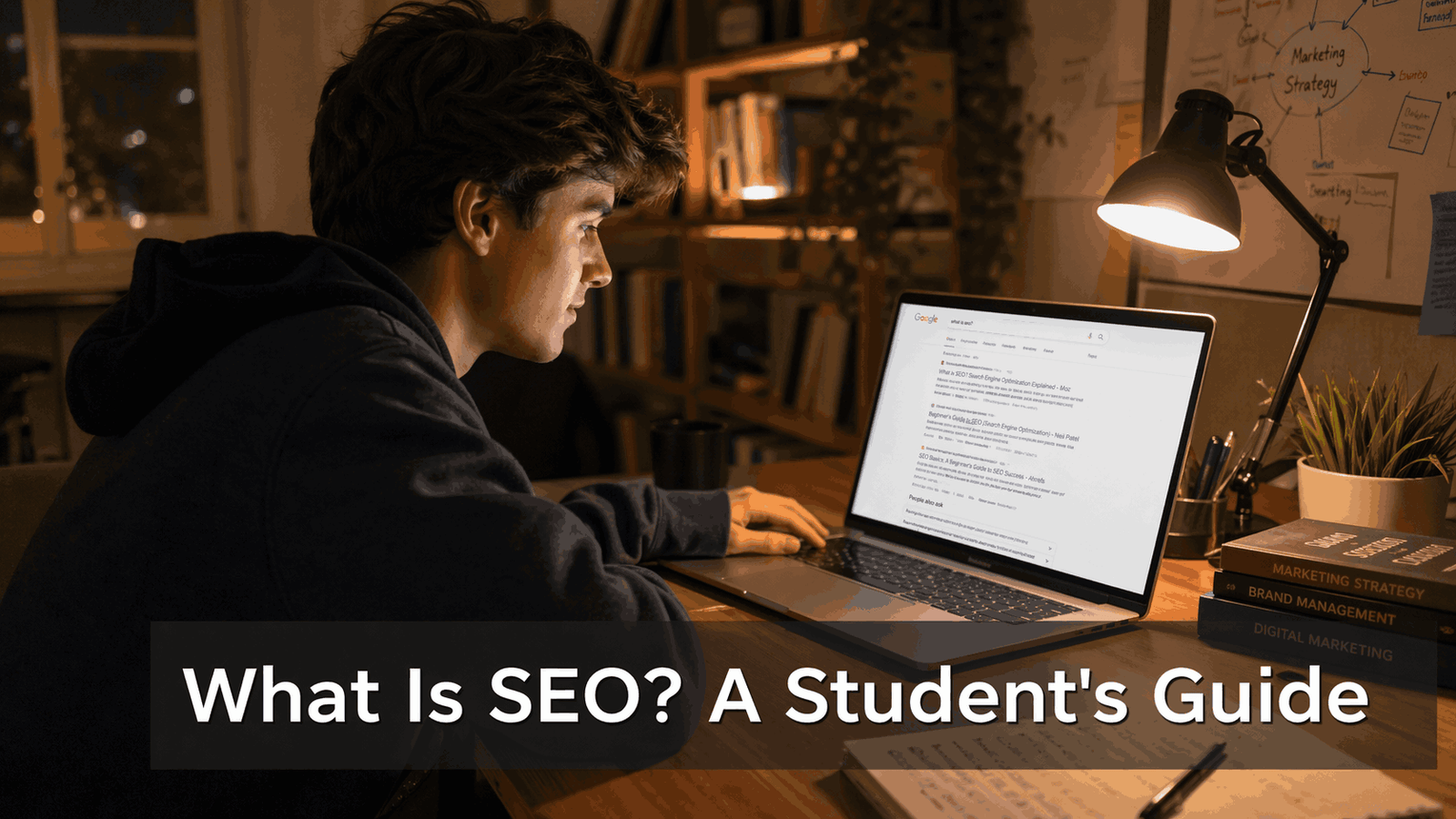
It’s 11:47 PM. You’re three tabs deep into a Google search trying to salvage an essay on climate policy. You click the first result, skim it, move to the second — never once wondering why those specific pages ended up at the top of millions of others. Almost no one does. But that automatic trust you placed in Google’s ranking? That’s exactly what SEO is built on.
That is why understanding what SEO for students really means can give you an advantage long before graduation.
If you’ve heard the term thrown around in marketing classes or LinkedIn posts and assumed it had nothing to do with you, I get it. Most SEO content is written for business owners and brand managers, not students trying to figure out what skills actually matter after graduation. The skepticism is reasonable.
Here’s the problem though: the job market in 2025 has shifted hard toward candidates who understand how digital content works, and SEO sits at the center of that shift. Whether you’re heading into journalism, business, nonprofit work, or anything that touches the internet, employers increasingly expect you to speak this language.
This article breaks down what SEO actually is, strips away the jargon, and explains — plainly — why understanding it now gives you a real advantage before you ever hand anyone a resume.
What Is SEO for Students in Simple Terms?
SEO stands for Search Engine Optimization. Strip away the jargon and it means this: making content easy for search engines — mainly Google — to find, understand, and recommend to people.
Every time you search for something, Google scans billions of pages and ranks them by how well they match what you’re looking for. SEO is the set of strategies that determine which pages win that ranking. It’s not magic, it’s not hacking — it’s understanding the rules of a system that now governs how most of the world finds information.
Think of it like a massive library. Google is the librarian. SEO is knowing how to label, organize, and write your book so the librarian actually recommends it to readers.
There are three core pillars.
Technical SEO is about how your site is built — fast loading, mobile-friendly, easy for Google’s bots to crawl. Content SEO is about what you write and whether it genuinely answers what people are searching for. Authority SEO (often called link building) is about how many reputable sources point to your content, which signals trust.
You don’t need to master all three to benefit from understanding them.
Why Should Students — Not Just Marketers — Care About SEO?
Here’s the assumption most people make: SEO is a niche marketing skill for people running websites or online stores. That’s wrong.
SEO isn’t a marketing tool. It’s a literacy skill — and students who treat it that way will consistently outperform peers who don’t, across nearly every career path.
Here’s why that holds up.
If you’re in journalism, public policy, education, healthcare, or any field where communication matters, understanding how people search for information — and what makes content credible enough to surface — changes how you write, research, and present ideas. You start thinking about what your audience actually needs rather than what you assume they need. That’s not marketing. That’s clear thinking.
Beyond that, the career data is hard to ignore. According to LinkedIn’s annual jobs report, digital marketing roles — a category that almost always requires SEO knowledge — have been among the fastest-growing positions globally for three consecutive years. And because most students graduate without this skill, those who have it start their job search with a visible edge.
Even if you never work in marketing: if you blog, freelance, build a portfolio site, or want your work to be found online, SEO is how you make that happen. The alternative is publishing into a void.
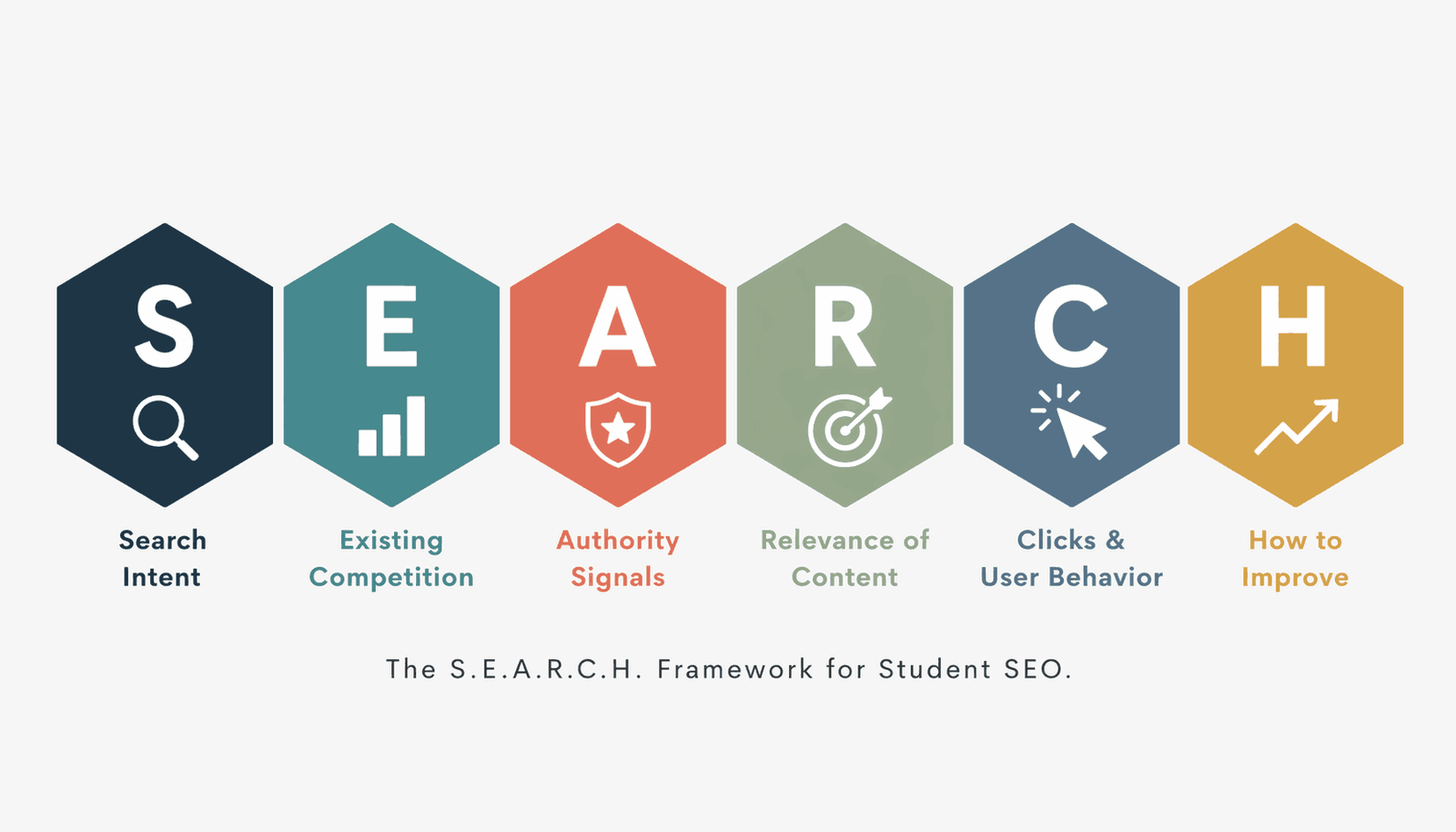
The S.E.A.R.C.H. Framework — A Student’s Way to Think About SEO
Most SEO guides dump a list of tactics on you. Instead, here’s a framework designed specifically for how students think and learn — called the S.E.A.R.C.H. Framework. Think of it as a mental model, not a checklist. It works whether you’re optimizing a blog post, a portfolio, or just trying to understand how Google works.
S — Search Intent: Before anything else, ask what the person searching actually wants. Are they looking for a quick answer, a how-to guide, or a product to buy? Every piece of content should be built around a specific intent. This is where most beginners go wrong — they write what they want to say instead of what the searcher needs to hear.
E — Existing Competition: Look at what’s already ranking for a keyword. If the top results are from BBC, Harvard, and WebMD, a new blog post probably won’t beat them. Find topics where you can realistically compete — usually specific, lower-volume questions that bigger sites haven’t bothered to answer properly.
A — Authority Signals: Google trusts sources that other trusted sources link to. As a beginner, you build authority slowly — by creating genuinely useful content, getting referenced by others, and keeping your site or portfolio credible and professional.
R — Relevance of Content: Your content has to actually match the keyword you’re targeting. This sounds obvious, but relevance is about depth and specificity, not just mentioning a keyword. A page titled “Study Tips” that spends two paragraphs on each tip ranks worse than one that thoroughly answers one specific study problem.
C — Clicks and User Behavior: Google watches what happens after someone clicks. If they leave in three seconds, that’s a signal the content didn’t deliver. Write so people stay, read, and find what they came for.
H — How to Improve Over Time: SEO is not one-and-done. Rankings shift. Content gets stale. The students and professionals who win at SEO treat it as an ongoing process of learning and updating, not a box to check.
Use this framework before you write anything meant to be found online. It’ll save you hours of guesswork.
Example Scenario — How One Student Could Use SEO to Land a Job Before Graduation
Priya, a 21-year-old communications student, started a blog in her second year covering mental health resources for college students. She wasn’t an SEO expert — she’d taken a free Google Digital Garage course and read a few articles. But she applied the basics: she targeted specific long-tail keywords like “how to manage exam anxiety without medication” instead of broad terms like “mental health tips.” She updated posts quarterly and earned a few links from student union websites.
Within eight months, her blog was averaging 4,200 monthly visitors. One post alone brought in 900 visits in a single month.
When she applied for a content role at a mid-size health tech startup, she brought a one-page summary of her blog’s performance — traffic growth, top-ranking articles, keyword targets. She was hired over candidates with marketing degrees. The hiring manager later told her it was the only application that showed real-world results rather than theoretical coursework.
The blog took roughly 3–4 hours per week to maintain. The return was a full-time job offer before she graduated.
Why This Matters More Right Now Than It Did Two Years Ago
Two years ago, churning out a high volume of mediocre content could still get you decent Google traffic. That playbook is dead.
Google’s Helpful Content Updates — rolled out aggressively from 2022 through 2024 — fundamentally changed how content is evaluated. Google’s ranking systems aim to reward helpful, reliable, people-first content that shows experience, expertise, authoritativeness, and trustworthiness. Generic, surface-level content gets buried. Content written by people who clearly know what they’re talking about — and can demonstrate real experience gets rewarded.
This is actually great news for students. It means the internet is increasingly favoring genuine knowledge over keyword stuffing. A student who writes a detailed, honest, experience-based article on a topic they’ve actually studied will outperform AI-generated filler. The bar for quality has gone up, and students who understand that bar can clear it.
Then consider the numbers. Search engines still shape how people discover information online. If you create a portfolio, blog, or student project page without understanding SEO, you are building in a room with no windows. People exist. They are searching. They just cannot find you.
Common Mistakes Students Make When Learning SEO
Most students who try SEO stumble in predictable ways. Here’s what to avoid.
1. Chasing high-volume keywords immediately. Typing “productivity tips” into a keyword tool and seeing 500,000 monthly searches feels exciting. But ranking for that term as a new site is nearly impossible. Start with specific, lower-competition keywords — “best study schedule for nursing students” gets fewer searches but is far more winnable.
2. Writing for the algorithm instead of the reader. Stuffing a keyword into every other sentence doesn’t help rankings — it actively hurts them. Google is sophisticated enough to understand context. Write for humans first. The algorithm follows.
3. Publishing and abandoning. One of the biggest SEO myths is that you write something once and the traffic flows forever. Content needs to be updated, especially anything involving statistics, tools, or current events. A post from 2022 with outdated information will slowly lose its ranking.
4. Ignoring the title and meta description. These are what people see in search results before they click. A poorly written title — even on great content — tanks your click-through rate. Spend real time on these two elements.
5. Treating SEO as separate from writing quality. The students who get this right quickly are the ones who realize: good SEO is just good writing with strategic structure. Clarity, usefulness, and depth are SEO. They’re not separate things.
How to Start Learning SEO as a Student (Without Spending a Cent)
You don’t need a $500 course. Here’s a realistic starting path.
Google’s own Search Central documentation is free, accurate, and written for beginners — start there for fundamentals. Google Digital Garage offers a free certified course on digital marketing that covers SEO practically, not theoretically.
For keyword research, Google Search itself is a tool. Look at autocomplete suggestions and the “People Also Ask” box. These tell you exactly what real people are searching for. Ubersuggest has a free tier that’s more than enough for anyone just getting started.
Install Google Search Console on any site you create. It shows you which queries bring people to your content, what your average ranking position is, and which pages are performing. This data will teach you more than any course.
Set aside two hours a week. That’s it. Consistent, low-pressure learning compounds faster than crash-course cramming — which, if you’ve ever pulled an all-nighter before an exam, you already know doesn’t stick.
Frequently Asked Questions About SEO for Students
Q: Do I need a website to learn SEO? Not at all — though having one helps you practice. You can start by analyzing existing websites, using free tools to research keywords, and studying why certain pages rank the way they do. A personal portfolio site or a simple blog on WordPress or Blogger gives you a real environment to experiment without spending anything.
Q: How long does it take to see SEO results? Most SEO professionals estimate three to six months before new content starts ranking noticeably. This isn’t a reason to delay — it’s a reason to start now. The effort compounds over time. Students who start in their first or second year often have tangible results — and a portfolio of evidence — by the time they graduate.
Q: Is SEO still relevant now that AI tools like ChatGPT exist? More relevant than ever, not less. AI tools are changing how people search, but the underlying logic of search — matching intent to quality content, building trust, making information findable — hasn’t changed. As AI-generated content floods the internet, human-written content with clear expertise and genuine experience is becoming more valuable to search engines, not less.
Q: Can SEO help with academic research skills? Yes, in a surprisingly direct way. SEO teaches you to think carefully about what people are actually looking for, how to evaluate source credibility, and how to structure information for clarity. These are the same skills that make a strong academic researcher. Understanding search intent, for example, maps directly onto understanding your audience when writing essays or reports.
Q: What’s the easiest type of SEO to start with? On-page content SEO — choosing the right keywords, structuring your content with clear headings, writing with genuine depth — is the most accessible entry point. No technical skills, no money, no external dependencies. You can apply it immediately to any blog post, LinkedIn article, or portfolio page you create.
Start Before Everyone Else Does
Most students won’t read an article like this one. Most will graduate having used Google every day for four years without ever asking how it works. That gap is your opportunity.
SEO rewards people who start early and practice consistently. You don’t need to become an expert. You need enough understanding to write content people can actually find, to make your portfolio visible, and to walk into a job interview with real results to show — not coursework, results.
Pick one platform — a blog, a portfolio, a LinkedIn page. Apply what you’ve learned here. Use the S.E.A.R.C.H. Framework to guide your first piece of content. Install Google Search Console. Give it three months.
The students who understand how the internet actually works will have a serious edge over those who don’t. Be one of them.
Recommended next step: Start with Google’s free Search Central documentation, then set up a free Google Search Console account on any website you own or create. These two steps take under an hour and will give you a practical foundation that most graduates don’t have.

Noman Ali is a student and beginner digital skills writer behind NaqVentures. He writes practical guides about AI tools, automation, SEO, blogging, and student productivity based on real learning, testing, and beginner-focused workflows.
Really nice and thoughtfully put. In the era of AI, it feels good to come across some original work.